

“Cannabis Inherits Its Future” is a three-part feature covering the science, the bottlenecks and the path forward for cannabis breeding.
Read Part 1 — The Genetic Legacy Loop — here.
Part 2 — What the Eye Can’t See — explores how trichomes, genomes, machine vision, polyploidy and new breeding frontiers could finally move cannabis beyond its genetic bottleneck.
PART 2 of 3
WHAT THE EYE CAN’T SEE
In This Article
The industry was selling a product whose manufacturing process it could not draw
Reading the Trichome
For most of cannabis history, the source of the drug was a black box. Everyone knew the sticky resin glands coating the flower — the trichomes — were where potency came from. But the process inside them — how the cells are organised, where exactly the chemistry happens, how raw materials move through the gland — remained unclear.
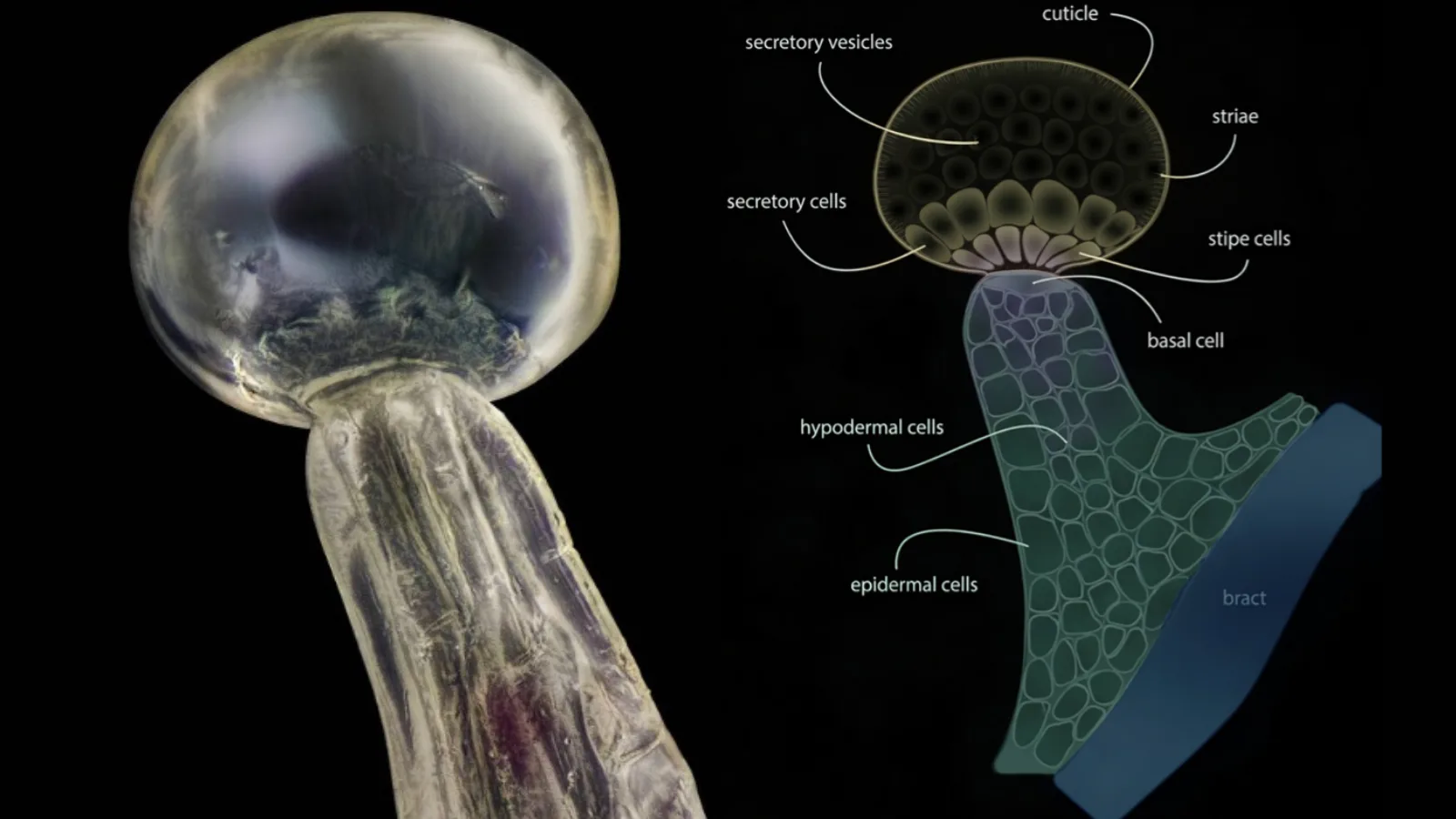
The reason the plant bothers with these glands at all comes down to self-defence. Cannabinoids and terpenes evolved as toxins: the plant makes them to deter the insects that would eat its flowers, but they would damage its own tissues if it didn’t store them outside its cells — making them even throws off a dose of natural bleach as a byproduct. So it compartmentalises the whole operation. The disc cells at the base of each gland make the compounds, then push them out through their outer wall into a sealed pocket under the gland’s waxy skin, walled off from the cells that made them. The stalked trichomes reach 200–500 micrometres, big enough to see with the naked eye, and each one is a self-contained biochemical factory — the source of everything the market calls “potency and aroma”.
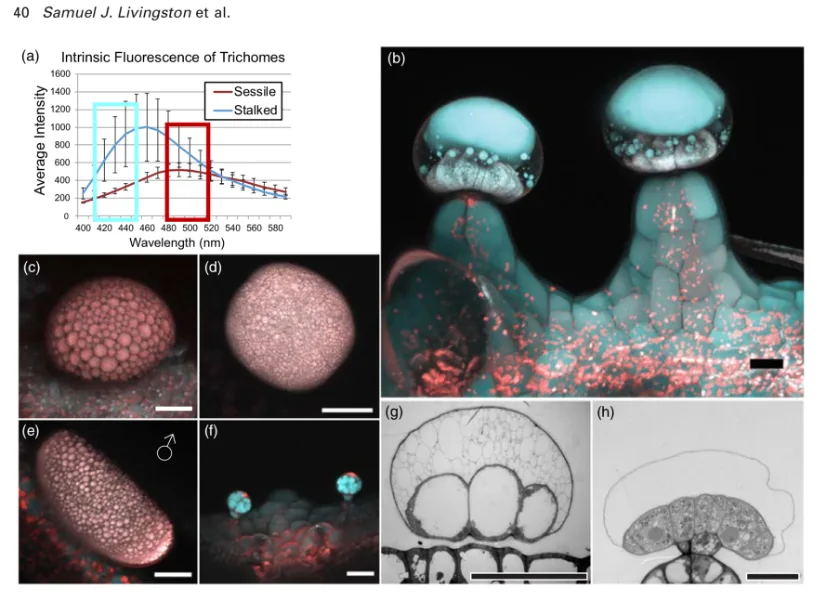
Between 2020 and 2024, a series of studies at the University of British Columbia opened the box. A 2020 paper in The Plant Journal used live-cell imaging to show that trichome anatomy reorganises as flowers mature. A 2021 follow-up mapped the cell-wall remodelling that builds the storage cavity.
The 2022 paper delivered the punchline: a mature glandular trichome is a polarised “supercell.” That means the gland’s interior is organised like a production line — raw materials enter at the base, pass through a chain of specialised structures, and finished cannabinoids and terpenes are pushed out the top into a sealed external storage cavity. A ring of disc cells, wired together by tiny channels through their shared walls, pumps cannabinoids and terpenes through their outward-facing surface into that cavity. THCA synthase, the enzyme that completes the final step in the production of the THCA molecule, sits at that outward face — a localisation first hinted at in 2005 and now confirmed at electron-microscope resolution. A 2024 review by the same group calls the trichome what it actually is: a biofactory.
That is the engineering diagram of cannabis potency. Until 2020, the industry was selling a product whose manufacturing process it could not draw.
Why this matters for breeding is more important than the biology. Potency is not one thing. It is the multiplication of several: how many trichomes a plant produces, how big they grow, how long they keep secreting, how efficiently each disc cell catalyses each reaction. A plant with twice the density and half the per-trichome output could look identical on a certificate of analysis but has a completely different breeding profile.
The typical pheno-hunt cannot see this. The eye and the bench assay see the final number. They cannot see which underlying mechanism produced it. For fifty years, breeders have selected for “high THC” without knowing whether they were selecting for more factories, bigger factories, or faster ones — and without any way to recombine those traits independently.
The trichome work changes this in a specific, exploitable way. If trichome number is governed by one set of genes and trichome productivity by another, those genes — once mapped — become handles. You grab a high-density trait from one plant, a high-productivity trait from another, and combine them. More importantly, you could in principle grab the trichome traits out of the narrow genetic base that dominates commercial cannabis — the handful of closely related families behind most of today’s top-shelf cultivars — and move them into landrace material from Malana, the Hindu Kush corridor, or the Russian steppe — plants with disease resistance and chemotypic palettes the commercial pool has never seen — without losing the commercial phenotype on the way over.
Plant breeders call this introgression. A transplant operation: take a useful trait out of a donor plant, slide it into a different genetic background, leave everything else about the recipient intact. The only published example of this in cannabis at molecular resolution is the CBDAS introgression from hemp into marijuana ancestry in 2021 — and that is a chemotype gene, not a trichome trait. No peer-reviewed programme has yet introgressed trichome traits in cannabis. The capability exists at every individual step. The integrated programme does not. That gap — between what the science now permits and what the industry has actually built — is what the rest of this piece is about. The first missing piece is navigation.
The Genome, in Plain Terms
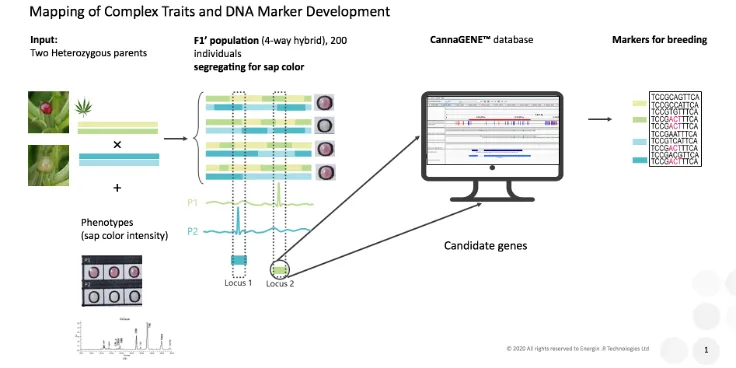
A genetic marker is a signpost. A short, identifiable stretch of DNA that sits next to a trait you care about and travels with it through generations. Know the marker and you can test a seedling at three weeks old — without waiting four months for it to flower, without burning canopy on plants that will not make the cut. You can stack two or three markers and select for combinations the eye could never resolve. Markers are the difference between breeding by intuition and breeding by design.
To find a marker you need a map. Cannabis got its first one in 2011, when the Purple Kush draft genome was sequenced. A 2019 physical map revealed the cannabinoid synthase region is a graveyard of broken gene copies sitting in a corner of the genome where normal genetic shuffling has effectively stopped. The 2021 CBDRx assembly became the species reference; Cannbio-2 and Medicinal Genomics’ Jamaican Lion sit alongside it. Phylos Bioscience built the first commercial product for quickly detecting tiny DNA differences across many samples on top of these maps. The Salk pangenome discussed in Part 1 The Genetic Legacy Loop now sits above all of them — a graph reference that captures variation across cultivars instead of comparing every plant to a single sample.
Two markers are in routine commercial use. Sex markers let breeders pull males out of a seed crop at the cotyledon stage instead of the flowering stage — a pollination-disaster prevention tool now standard at any serious operation. Chemotype markers let breeders sort THC-, CBD- and mixed-ratio seedlings before they flower.

Beyond chemotype and sex, the toolkit thins quickly. PM1 and PM2 remain the only disease-resistance markers to reach peer review. Autoflower1 and Early1, a pair of flowering-time markers out of Cornell, are the only others published. That is the entire list.
The genome-wide association studies that would fill it are just getting started. The first drug-type GWAS arrived only in 2024; a 2025 follow-up found thirty-three markers across eleven cannabinoid traits. There is no published HLVd resistance marker. Only one hemp study has linked a gene region to trichome density, and only with a rough visual score — nothing yet maps the resin-producing trichomes breeders actually select for. Genomic selection — the method that tripled genetic gain in maize — has barely been attempted in cannabis, and early results predict mainly CBD.
The genomes have been available since 2021. What cannabis has lacked is the ability to measure the plant properly — at scale, objectively, in numbers a computer can read. That is the next problem.
Teaching Machines to See
Cannabis has always been judged by eyes, hands, nose and the occasional bench assay. The measurements are real, but two pheno-hunters walking the same canopy will pick different keepers and neither will be able to articulate exactly why. Aroma is subjective. “Frosty” is debatable. Even a clean lab number is an average pulled from ground tissue, blind to whether the cannabinoid mass came from many small trichomes or a few large ones.
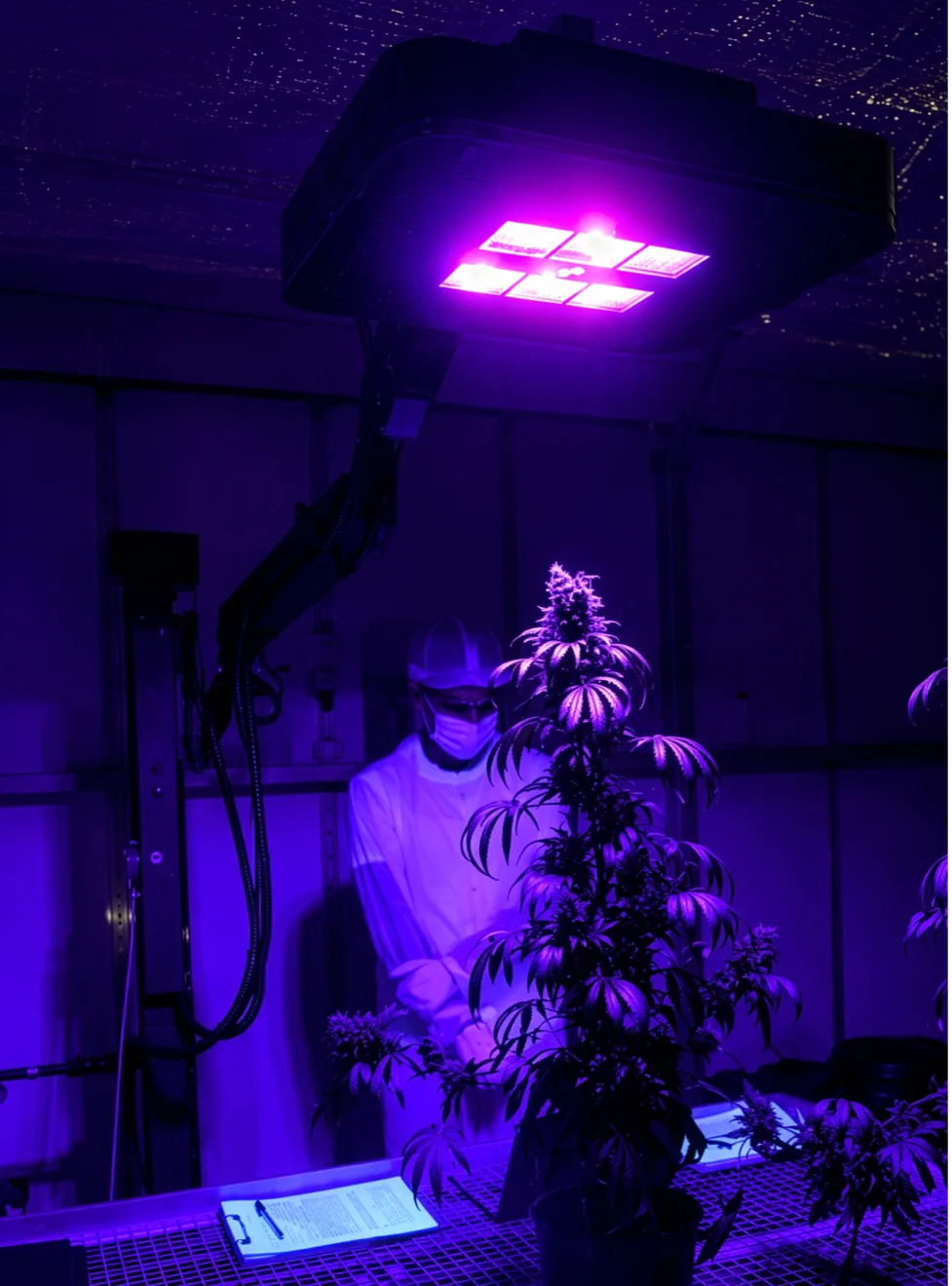
Other crops left this stage behind with high-throughput phenotyping: cameras, sensors and machine-learning models that measure thousands of plants per day on dozens of traits at once. Maize, wheat and Arabidopsis have been running on it for years. The German firm LemnaTec has been a standard vendor for that research for over two decades — its rigs helped drive modern crop breeding across all three species. Now the same infrastructure is being pointed at cannabis. Robert Tietz, LemnaTec’s Managing Director, puts the shift in grower terms:
“Technology supports the pheno-hunter with objective measurements — the human still steers. But how do you rate hundreds of plants consistently? On a production scale, it is impossible to assess with your eyes only. These tools evaluate more plants, and they are consistent.”
Start with the trichome. A 2023 study trained a deep-learning model on tens of thousands of macro-photographs to count glandular trichomes and sort them by maturity — clear, milky, amber — automatically. What took a technician an afternoon now takes a laptop a few seconds. The same study used ultraviolet-induced fluorescence to reveal something the naked eye never could: under UV light, trichome heads glow different colours depending on their cannabinoid load, and that glow shifts from blue-green to red as the resin matures. Morphology and chemistry, captured in a single frame. A 2026 follow-up pushed the same trichome-classification task onto a smartphone, hitting 98.6% accuracy against expert labels. Trichome scoring no longer needs a lab — any breeder with a phone can capture the data.
The chemistry side has its own version. Near-infrared spectroscopy — a handheld device that reads cannabinoid content from a flower without grinding it — has been benchmarked across multiple labs since 2018. Hyperspectral imaging goes further, reading hundreds of wavelengths at once instead of a narrow band. A 2022 study at Mississippi State used it to sort hemp cultivars at 99.6% accuracy and predict cannabinoid concentrations from fresh flowers without touching them. A 2023 collaboration between the University of Adelaide and Germany’s Fraunhofer Institute showed leaf scans could identify plant sex — with perfect accuracy at flowering in one cultivar, and 60–87% accuracy from juvenile leaves across others. A 2025 Adelaide study used handheld leaf scans during flowering to predict final harvest THC with an R² of 0.77 — not lab-accurate enough for compliance, but accurate enough to rank plants weeks before harvest, which is the use case that matters for selection.
Here is where it gets interesting. Once trichome size, shape, colour and density are measured objectively across thousands of plants, those numbers can be lined up against the genome to find which DNA variants drive each trait. The cameras exist. The sequencing exists. Nobody has yet put them together at scale. When someone does, breeders stop guessing which plant to keep and start knowing.
The Dresden startup SpexAi is building toward exactly that integration. Their HUGIN sensor pairs hyperspectral imaging with computer vision trained on cannabis, scoring every plant in a room on flower structure, trichome coverage, leaf health and predicted cannabinoid content — all as a non-destructive scan.
Ben Niehaus, SpexAi’s CEO and Founder, puts the case plainly:
“The human eye sees three colours; a hyperspectral camera sees more than a hundred. Most of what a breeder cares about — cannabinoid concentration, water stress, early disease, the precursors that decide a terpene profile — lives in the bands the eye cannot see. The value is timing, speed and cost: the signal arrives weeks before harvest, while there is still time to make a decision.”
In June 2025, SpexAi was acquired by LemnaTec — closing the loop between the company that built phenotyping for mainstream agriculture and the startup that adapted it for cannabis. The technology is not new to plant science. It is new to this crop.
At La Trobe University in Melbourne, researchers put the same sensor to work — training the computer to predict how much of each cannabinoid a plant is making, across many different strains and growing conditions.
More of Everything: Polyploidy
Markers and imaging widen the bottleneck by making selection smarter. Polyploidy tries something cruder, and breeders have used it on every important commercial fruit you’ve ever eaten. Seedless watermelons. Most bananas. The wine grapes in your glass. The technique predates the discovery of DNA’s structure — breeders have been deliberately doubling chromosomes since a 1937 study that colchicine, an alkaloid from autumn crocus, could do the job — and it is brutally simple: add an extra set of chromosomes.
Most plants are diploid — two copies of every chromosome, one from each parent. Treat a seedling with a mitosis-blocking chemical such as colchicine or oryzalin and a small fraction of cells will fail to separate after duplicating their DNA, producing a tetraploid: four copies of every chromosome, the same genetics but doubled. Cross a tetraploid back to a diploid and you get a triploid: three copies — an odd number, which makes the plant sexually sterile because chromosomes cannot pair evenly during meiosis. The triploid cannot make viable seeds. From the grower’s perspective, that is a feature, not a bug.
In cannabis, the case for triploids comes down to one word: pollen. Cannabis pollen is small, prolific, and wind-borne — a single male plant can release roughly 100 million grains, and pollen has been documented drifting tens of kilometres from its source. A single missed male upwind of an outdoor cannabinoid hemp crop can pollinate a whole field, divert the female plants’ metabolic budget into seeds instead of cannabinoids, and ruin the harvest. A triploid female cannot be successfully pollinated. The flower stays sinsemilla regardless of what blows in.
The peer-reviewed evidence is solid. Oregon CBD published the foundational 2021 paper on a CBG triploid hemp cultivar; a 2024 NC State study demonstrated reduced seed set under pollen pressure across six site-years of trials in Kentucky, New York and North Carolina; a UConn trial the same year reported roughly 99.5% lower seed counts in triploids than diploids.
The sterility insurance is real, and agronomic performance is comparable to diploids. Naturally occurring triploid cannabis exists — averaging about 1 in 200 plants across populations and rising to roughly 2.3% in self-pollinated ones — which suggests breeders were probably already keeping unintentional triploid mothers without realising it.
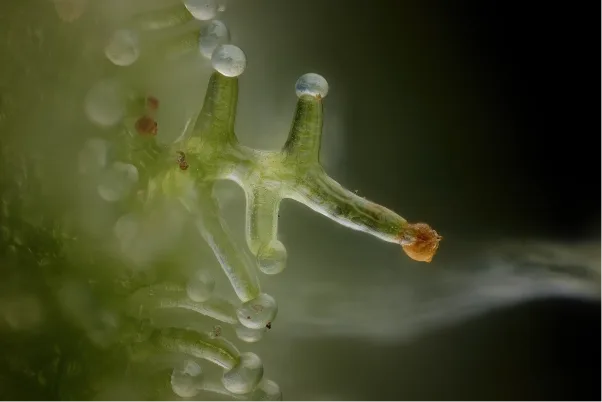
In February 2024, Humboldt Seed Company brought what it bills as the first high-potency drug-type triploids — OG Kush and Donutz — to the commercial seed market, bred by Dark Heart’s Richard Philbrook (first author of that paper) via the standard tetraploid-to-diploid cross. Under macro magnification the change is striking: the triploid trichomes are visibly enlarged and appear to branch and shoot off from one another.
Horticulturist Ed Rosenthal, observing a field trial, reported denser trichome coverage and more stress-resistant plants than diploid controls, though the company’s headline THC and yield gains rest on in-house figures rather than published trials.
The case for tetraploids is messier. Marketing materials promise bigger plants, larger flowers, and elevated cannabinoid content. The peer-reviewed picture is more equivocal. The 2019 Canopy Growth study reported roughly a 40% increase in trichome density on sugar leaves and a 9% bump in CBD in tetraploid drug-type plants. A 2023 study across four cultivars found the opposite — total cannabinoids, THCA, CBDA and CBGA all decreased significantly with higher ploidy. A 2025 paper using machine-learning-optimised oryzalin protocols cracked the induction-efficiency problem, achieving 93.75% tetraploid recovery, but the chemistry question remains contested. The honest framing is that ploidy effects in cannabis appear to be cultivar-dependent, sometimes dramatically so.
As Francesco Tonolo, cannabis plant biologist at Leiden University, puts it:
“Polyploidy is a powerful breeding tool in Cannabis, but its impact on quality compounds is unpredictable and depends strongly on the genetic background of each cultivar.”
The same study found that terpene profiles were equally unpredictable — two cultivars produced more volatiles as tetraploids, two produced less — and that novel compounds absent in diploids sometimes appeared at higher ploidy levels, adding a layer of chemical complexity that breeders are only beginning to map.
Triploids are, for now, the cleanest commercial polyploid play in cannabis: pollen-drift insurance for outdoor and greenhouse production, sold honestly. Tetraploids remain a research-grade tool whose commercial value depends on which cultivar you start with.
Two final points. Polyploidy is not genetic modification — no foreign DNA enters the plant; only the plant’s own chromosomes are duplicated, exactly as happens spontaneously in wild populations. A triploid cannabis cultivar is not a GMO. And polyploidy is not a substitute for good genetics. A triploid version of a mediocre cultivar is still a mediocre cultivar — perhaps a little bigger, and seedless, but the chemotype, terpene profile, disease resistance and structure all come from the diploid base. The ploidy is the frame; the picture is still the picture.
The Frontier Rarely Talked About
Every tool so far works within the plant’s own DNA. The next set does not (at least, not exclusively) — and the industry mostly does not talk about it.
In cannabis biotech, the first job is delivery: getting genetic instructions inside a cell. The old workhorse is Agrobacterium tumefaciens, a soil bacterium that naturally smuggles DNA into plant cells. By 2003, hemp had been infected this way. Other routes matter too.
A gene gun shoots DNA-coated gold dust through the cell wall — blunt, but useful because it can hit chloroplasts, which carry their own small genome. Other crops have already engineered that second genome for insect resistance and herbicide tolerance. Cannabis has had the chloroplast map since 2015; nobody has used it yet.
Beyond bacteria and gene guns, newer delivery methods are being tested too. Gold/silica nanoparticles can be infiltrated into intact cannabis leaves; within five days, the genetic cargo can show up in leaf cells, including the resin-making trichomes. PEG delivery pushes DNA into plant cells temporarily stripped of their hard outer casing at roughly 23% efficiency. A 2025 protocol lifted that to about 28%, got cells dividing and forming small clumps of new tissue, but still did not regenerate a full plant.
That last clause is the catch. Delivery proves the message got in. Regeneration proves the edited cell can become a crop. Cannabis has been notoriously bad at that: many papers show a gene switching on for a few days, then the tissue stalls. “Transient” means the instruction worked briefly. “Stable” means the change is built into the plant and can be inherited. That distinction separates a lab signal from a new cultivar.
This is where the field has changed since 2022. Researchers now have faster seedling assays, better transient-expression systems, stronger cell culture, and a 2025 shoot-regeneration method that worked across tested hemp and medicinal cannabis genotypes. That does not make cannabis easy. It means the old wall — “we can edit cells but not recover plants” — is starting to crack.
Some tools avoid the wall. Virus-induced gene silencing uses a modified plant virus as a temporary dimmer switch: it turns a chosen gene down without rewriting the plant. Cannabis marker genes were knocked down by about 70–73%. That is not a commercial cultivar, but it is powerful: it lets researchers test what a gene does without spending a year building a stable line.
CRISPR is sharper. It can cut a chosen spot in the plant’s own DNA, letting breeders knock out a gene without adding a foreign one. The first peer-reviewed cannabis CRISPR paper, published in 2021, knocked out a pigment gene whose loss makes pale seedlings — an easy visual confirmation that the edit worked.
Not every genetics tool makes a deliberate cut. TILLING is mutation breeding with a search engine. First you soak seeds in a chemical mutagen — usually EMS — which chemically alters individual DNA bases so they get miscopied when the cell divides, peppering the genome with thousands of random single-letter typos. Then you sequence the whole collection to find the one plant where the useful accident happened. In 2025, TILLCANN created 1,633 cannabis mutant families, giving breeders a non-transgenic way to hunt for altered genes without crossing species boundaries.
The mutagen doesn’t have to be a chemical. Radiation does the same job by a different route: ionising kinds like X-rays and gamma rays that break DNA strands, or non-ionising UV that fuses adjacent bases into errors. At the speculative edge, MartianGrow is betting on the radiation environment of space itself — expose cannabis genetics to spaceflight, recover them, then sequence and select whatever useful variation survives.
The current edge is no longer theoretical. Wisconsin’s Crop Innovation Center says its hemp platform is genotype-flexible, fee-for-service, and typically seed-to-seed in about eight months. APHIS has already found that University of Wisconsin hemp with reduced THC and CBD was unlikely to pose increased plant-pest risk under 7 CFR part 340. The hemp variety, dubbed “Badger G”, knocks out CBDAS, pushing chemistry away from THC/CBD and toward CBG. Badger Zero and Badger PMR followed: one described as cannabinoid-free, the other powdery-mildew resistant. The Israeli startup CanBreed has announced fungus-resistant cannabis, but without peer-reviewed proof.
The same tools can go a step further: not just editing cannabis’s own chemistry, but leveraging the molecular machinery native to cannabis trichomes to produce related compounds found in other plants.
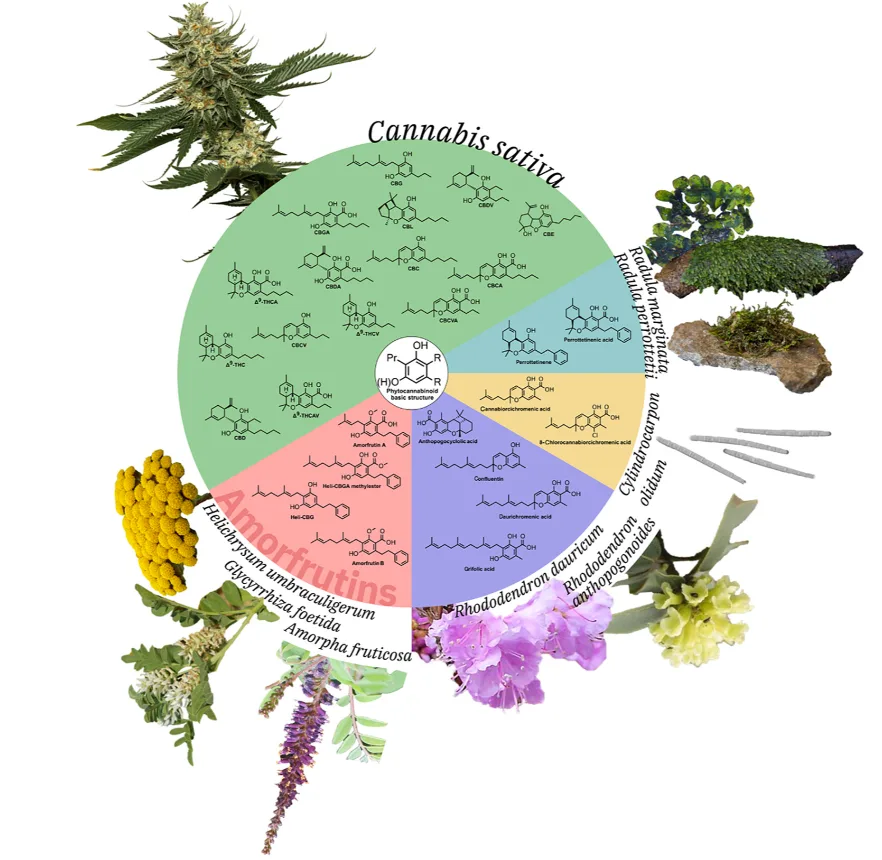
Phytocannabinoids aren’t exclusive to cannabis. The same class of compounds turns up as different versions in unrelated plants — rhododendrons, even some liverworts — most of them barely studied, because no one can get enough material to know whether they’re medically useful. If the steps each plant uses to build its version were worked out, those step-by-step pathways could be installed in cannabis itself. Cannabis is the obvious host: it already churns out this family of compounds at high volume per square metre, so it could turn a trace curiosity from another plant into research-scale quantities.
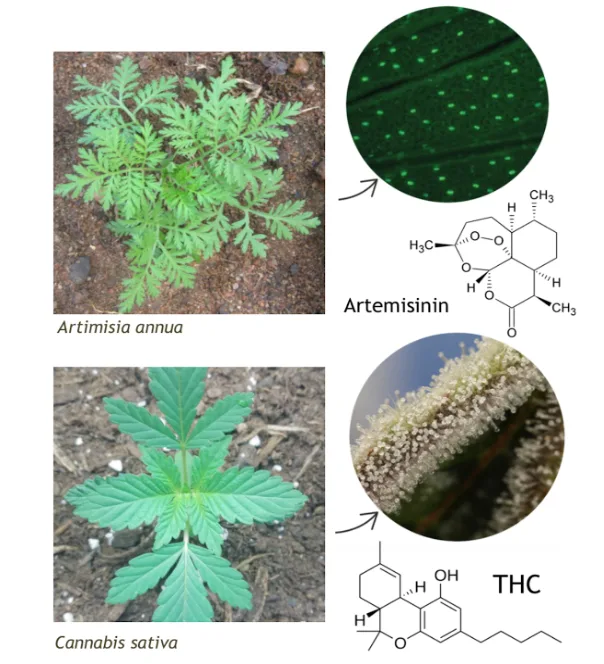
The same logic reaches beyond cannabinoids to drugs we already rely on. The world’s main malaria drug comes from sweet wormwood, which makes only stingy amounts — under 1% of its weight — so supply keeps falling short. Wormwood builds it the same way cannabis builds its own compounds: in the hairs on its leaves, from the same family of raw ingredients. So in principle you could transplant the wormwood’s recipe into cannabis and let its denser output do the work — plausibly hundreds of times more per patch of ground. No published work seems to have tried this in cannabis, and the hundreds-fold figure is a hopeful estimate, not a measured one. But all of this is transgenic — and that runs straight into something no lab can engineer around.
Regulation is the choke point outside the lab. The EMA GACP guideline does not ban genetically modified medicinal plants; it says they must comply with national and regional law. In Europe, that still means Directive 2001/18/EC, Regulation 1829/2003, and a slow approvals culture. The EU’s New Genomic Techniques framework may soften that for small edits, but as of 13 May 2026 it still awaited Parliament’s formal adoption. Add patient-facing brand risk and the patent thicket around cannabis chemotypes, including Biotech Institute LLC’s 2015 utility patent, and the commercial answer is still mostly: not yet.
Nature has already run the experiment. Across the plant kingdom there are countless molecules like these — over a hundred in cannabis alone, and far more in other plants: some toxic, some useless, a few that might be medicine — and almost none have been looked at. Cannabis is a plant that, in theory, could grow any one of them by the acre. The barriers are real but temporary: cost, proof, permission. The biology is there — and the tendency for technology to become cheaper and more accessible over time has a habit of dissolving everything in its way.
Key Takeaways
- Inside each trichome is a polarised cell factory — an organised production line for cannabinoids and terpenes, not a passive blob of resin.
- More factories, or faster ones? Breeders can finally tell the two apart.
- Introgression could transplant elite traits onto hardy landrace backgrounds — but nobody has done it yet.
- The genomes are sequenced; the markers breeders actually need are still scarce.
- Sex and chemotype remain the only markers in routine commercial use.
- Cameras and sensors now measure what the eye and nose cannot.
- AI trichome scoring on a smartphone: what took an afternoon takes seconds.
- Hyperspectral imaging reads cannabinoid potential weeks before harvest.
- Triploids can’t be pollinated — the cleanest crop insurance outdoor growers have.
- TILLING breeds by accident on purpose: scramble the DNA with a chemical or radiation, then read the genome to find the useful mistake.
- CRISPR works in cannabis cells; regenerating whole edited plants is still the wall.
- Phytocannabinoids aren’t unique to cannabis — and cannabis could be engineered to grow other plants’ rare compounds by the acre.
Subscribe for future articles, market insights, and developments shaping medicinal cannabis in APAC and beyond.
Join the genetics conversation at Agential Cannabis 2026, where cultivators, breeders, researchers, and commercial farms will connect in Bangkok this September.
Register by 30 June to save AUD 400 with Early Bird tickets →